









- » Focus and Scope
- » Section Policies
- » Peer Review Process
- » Publication Frequency
- » Archiving
- » Policy on the Use of Generative AI or AI-Assisted Technologies
- » Article Processing Charge (APC)
Focus and Scope
Journal Communication Spectrum: Capturing New Perspectives in Communication (JCS) is a blind peer-reviewed journal devoted to publishing research papers(fieldwork or textual studies), conceptual papers, and information concerning all aspects of communication, media studies, and cultural studies. It is a channel for discussing issues such as social media and online communication activities, public participatory communication, hospitality communication, gender and technologies, social, political, and sub-cultural movement, together with behavioural foundations of specific-interest communications, media engagement, and many other issues which provoke new perspectives in communication. The Journal will also consider papers in creativity studies, creativity ethics, creative design, creative media, creative industry, and creative economy in relation to both production, distribution and consumption of culture in the communications domain.
Published twice a year (in February and August), Journal Communication Spectrum follows a rigorous blind review process, in which reviewers and authors do not know each other, to ensure the objectivity of the assessment. Journal Communication Spectrum accepts manuscripts throughout the year in various fields and sub-fields of study for topics (but not limited to):
Communication Studies
- corporate communication, CSR, and public relations
- advertising, design, and creative communications
- journalism, broadcasting, and media management
- organizational, institutional, and industrial communication
- social and inter/cross-cultural communication
- governmental and political communication
- religion and spiritual communication
- health and family communication
- new media, cyberculture, and technological communication
- tourism, place, and environmental communication
- educational and developmental communication
- psychology of communication and love/intimacy studies
Media and Cultural Studies
- semiotics of communication, representation, and discourse studies
- political economy of communication, media, and sign
- law/ethics and the corruption of communication
- lifestyle, consumer culture, and brand studies
- media reception and audience studies
- gender communication, feminism, and queer studies
- fashion, food, game, and sports communication
- critical communication studies
- youth, film, visual culture, and music studies
- creative industry and creativity studies
Section Policies
Articles
 Open Submissions Open Submissions |
Indexed |
Peer Reviewed |
Peer Review Process
All papers in Journal Communication Spectrum: Capturing New Perspectives in Communication have undergone rigorous peer review, based on initial editor screening, and double blind review by two anonymous reviewers.
In the review process, reviewers consider the correspondence of title, abstract, findings, discussion, and conclusions. In addition, reviewers also consider the novelty, scientific impact and references used in the paper.
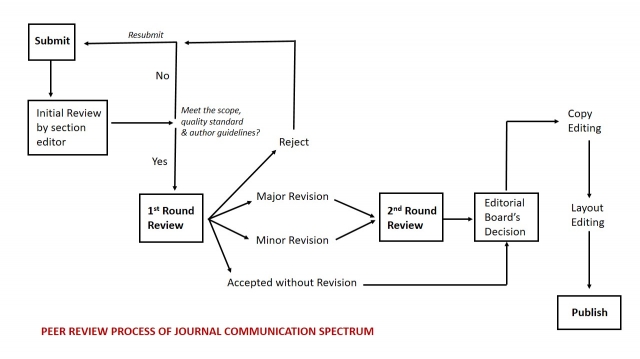
All manuscripts sent to the Journal Communication Spectrum: Capturing New Perspectives in Communication will go through an initial review process by the Section Editor. The editor will check whether or not according to the scope of the journal, meet the author guidelines and academic quality standards. If not, the editor will ask the authors to refine the manuscript and resubmit. If appropriate, the article will go through the Double-Blind Review process, either by the internal or external peer reviewer. As soon as two or more anonymous peer reviewers complete their review, the editor decides to accept without revision, reject, or invite the author to submit revisions (major or minor) based on reviewers' recommendations. After the revision, the manuscript review process entered the second round. Editorial team members, according to their expertise, will do final review and decide whether to accept manuscript or not to begin the editing process. After going through copy and layout editing, as soon as possible, the manuscript is published (at least if there is a delay, we will announce the table of contents and metadata with the status "in-press").
If a Section Editor or Editorial Board member is the author or co-author of the manuscript submitted, the manuscript will be handled by other Section Editor or Editorial Board members without the author or co-author of the manuscript knowing. This rule is vital to ensure the objectivity of the review process. If there is a problem regarding the review process, chief editor will take over the editorial work and give the final decision.
Meanwhile, the time required for the review process varies depending on the time for reviewers to submit their review, the author's revisions, and the editor's decision. The editors can make decision at any time and will tell the author(s) whether the manuscript is required to make some revisions, accepted, or rejected. But usually, if the manuscript needs revisions, the authors are asked to send the change within two weeks. We also ask our reviewers to complete their review no later than two weeks. However, we give the possibility of additional time for authors and reviewers. For information regarding article submission and requirements, please see the JCS Author Guidelines.
Publication Frequency
Journal Communication Spectrum is published twice a year every February and August. Authors can submit their article anytime throughout the year.
Open Access Policy
This journal provides immediate open access to its content on the principle that making research freely available to the public supports a greater global exchange of knowledge.
The APC for open access is IDR 1,000,000,- or IDR 2,000,000,- (for Bahasa Indonesia submission). Authors will be notified via email by the editorial secretary after author revision and accept's editorial decision. Cancellation Fee IDR 1,000,000,- or USD 50,0 will be charged for article withdrawn during or after reviewing process.
Archiving
This journal utilizes the LOCKSS system to create a distributed archiving system among participating libraries and permits those libraries to create permanent archives of the journal for purposes of preservation and restoration. More...
Policy on the Use of Generative AI or AI-Assisted Technologies
Journal Communication Spectrum (JCS) recognizes the potential value of AI in academic writing and acknowledges that the technology is advancing quickly. We, therefore, offer the following as a guide:
Generative AI and AI-assisted technologies can be used when preparing a manuscript for JCS. Where authors use AI technologies in the writing process, these technologies should be used only to improve the written expression and readability of the work and not to replace essential authoring tasks such as the framing of arguments. Any use of AI must be displayed in an “AI Acknowledgement” section of the work, explaining how it has been used as a functional tool to assist in the process of drafting. One of the following statements must be included:
- The authors declare that generative AI and AI-assisted technologies were not used in any way to prepare, write, or complete this manuscript. The authors confirm that they are the sole authors of this article and take full responsibility for the content therein, as outlined in COPE recommendations.
or
- The authors acknowledge the use of [insert AI system(s) and link] to [specific use of generative and/or assisted AI]. The prompts used include [list of prompts]. The output from these prompts was used to [explain use]. While the authors acknowledge the usage of AI, they maintain that they are the sole authors of this article and take full responsibility for the content therein, as outlined in COPE recommendations.
The use of AI does not preclude papers going through our publication workflow, as long as the correct acknowledgment is included. However, the Editorial Team reserves the right to withdraw an article at any point if the use of AI is considered inappropriate or if full disclosure has not been supplied.
A word of caution: We strongly recommend that you exercise caution if using AI tools for references/citations, as this can result in errors or fabricated details. It is the author's responsibility to cross-check references/citations against the original source material prior to submission. Manuscripts found to have unverifiable references at any stage in the publication process will be withdrawn from consideration.
Please note that content generated by AI tools does not meet the requirement of “authorship,” and you cannot list AI and AI-assisted technologies as an author or co-author. Also, as Generative AI does not reliably present facts or report its sources, it cannot be cited as a reference in a scholarly work.
Our guidelines align with the Committee on Publication Ethics (COPE) position statement: "Authors are fully responsible for the content of their manuscript, even those parts produced by an AI tool, and are thus liable for any breach of publication ethics."
AI and Peer Review Policy
Peer reviewers should be aware of JCS’ AI policy, as noted above. Using the same principles, reviewers may use AI to assist them with their writing, but they may not use AI to generate the review itself.Article Processing Charge (APC)
The JCS is an international, open-access journal available worldwide for free. To cover operational costs, this journal charges the following author fees (NOTE: APC is invoiced only if the article has been accepted for publication).
- Article in English: 1,000,000.00 (IDR) or 50.00 (USD)
- Article in Bahasa Indonesia: 2,000,000.00 (IDR) incl. translation and proofreading cost.
- Cancellation Fee (for article withdrawn by the author during or after reviewing process): 1,000,000.00 (IDR) or 50.00 (USD)
Transfer to:
Bank Permata Account No. 0701627415
Account Name: Universitas BakrieIndexed by:















Archived in:








Listed in:

INTERNATIONAL ASSOCIATION FOR MEDIA AND COMMUNICATION RESEARCH